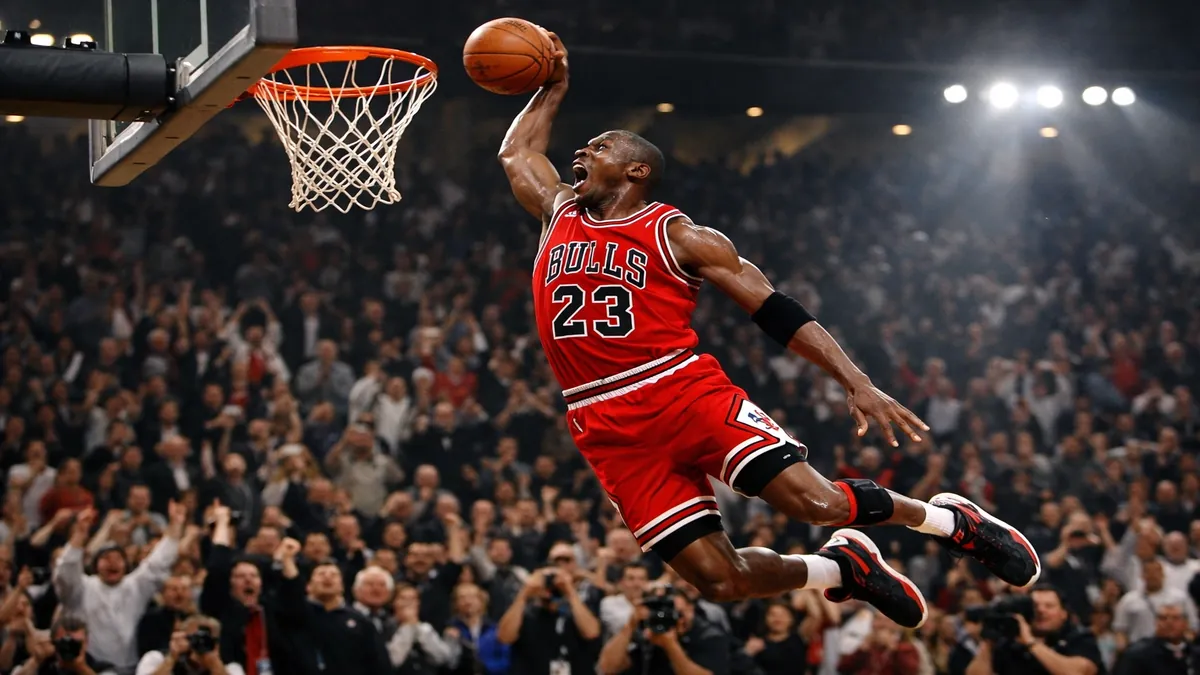
More than twenty years after his final NBA game, Michael Jordan remains the reference point for basketball greatness. His six championships, his perfect Finals record and his cultural reach have made him a permanent part of how the sport measures its best players.
The Making of a Competitor
Jordan was cut from his high school varsity team as a sophomore — a slight he later described as the moment his competitive obsession was born. He attended North Carolina, hit the winning shot in the 1982 NCAA final, and was drafted third overall by the Chicago Bulls in 1984.
The Championships
| Season | Opponent | Result | Finals MVP |
|---|---|---|---|
| 1991 | LA Lakers | 4–1 | Jordan |
| 1992 | Portland Trail Blazers | 4–2 | Jordan |
| 1993 | Phoenix Suns | 4–2 | Jordan |
| 1996 | Seattle SuperSonics | 4–2 | Jordan |
| 1997 | Utah Jazz | 4–2 | Jordan |
| 1998 | Utah Jazz | 4–2 | Jordan |

The Records
- Highest career scoring average in NBA history — 30.1 points per game
- Ten scoring titles — the most in league history
- Six Finals MVPs — every Finals he played, he won
- Five regular-season MVP awards
- Nine All-Defensive First Team selections
“I have failed over and over and over again in my life. And that is why I succeed.”
— Michael Jordan
Beyond Basketball
The Air Jordan line, launched in 1984, turned an athlete into a global commercial force and reshaped how sports brands market individual players. The 1996 film Space Jam and the 2020 documentary The Last Dance introduced him to two further generations.
The GOAT Debate
The debate with LeBron James is unresolvable because it compares different eras, rules and styles. What is not in dispute is Jordan's position at the centre of the conversation — he is the standard against which every successor is measured.